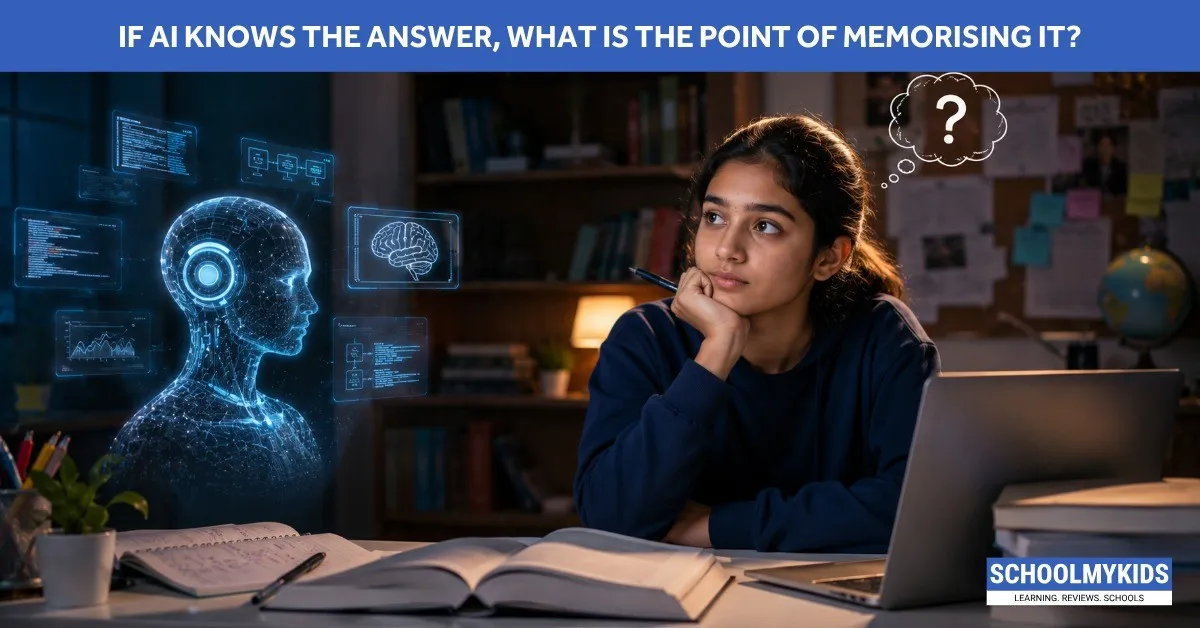
You're sitting with a JEE Physics problem. Need the lens formula. Instead of remembering it, you ask ChatGPT. It gives you the formula. You solve the problem correctly. You feel smart.
Then the exam happens. You can't use ChatGPT. Your brain goes blank because the formula was never actually in your head. It was in ChatGPT's response.
This isn’t a hypothetical. This is what research from 2024 and 2025 is actually showing.
The Data From Real Students
A 2024 field experiment with nearly 1,000 high school students found that those who used AI to solve math problems scored well while they had the AI. Once the AI was removed, their performance dropped. The tool did the thinking. Their brain did little. Little durable learning happened. (Bastani et al., Wharton/University of Pennsylvania, later published in PNAS 2025)
A 2025 randomized controlled trial measured retention. Students who used AI while studying scored 57.5 percent on a surprise test 45 days later. Students who studied without AI scored 68.5 percent. That is an 11 percentage point gap.
Researchers describe this as a performance paradox: AI raised immediate scores while weakening long-term retention. (Barcaui, 2025)
Why This Specifically Matters For Indian Competitive Exams
NEET and JEE aren't Google-accessible exams. You're locked in a room for three hours with your own brain.
NEET Biology draws the large majority of its questions directly from NCERT. Multiple analyses of recent papers put the figure well above 85 percent, with some years reaching 95 percent or higher. You still need to know the structure of nucleotides, functions of organelles, and classification systems. ChatGPT cannot help inside the exam hall.
JEE is shifting toward application-based problems. But the applications require formula knowledge first. You can't apply a formula if you don't know it exists or what it looks like.
Coaching-centre analyses of 2024 and 2025 papers show that purely direct formula-plug-in questions are declining. But the problem is students seeing that and thinking, "I don't need formulas."
Wrong. Formula reduction doesn't mean formula irrelevance. It means the test is checking if you understand formulas deeply enough to apply them in novel situations. That understanding only builds if you actually learned the formula at some point.
What Happens When You Outsource Everything To AI
Cognitive atrophy. That's the new term researchers use. Your thinking skills actually weaken from disuse.
It's like your brain is a muscle. If you outsource all the lifting to AI, your brain gets weaker. When you need it to actually perform (exam, interview, real-world problem), it can't.
A 2025 study of 666 participants found a significant negative correlation between frequent AI use and critical thinking skills. Students using AI regularly scored lower on critical thinking assessments than those who used it less. (Gerlich, Societies, 2025)
This isn't about smartness. It's about practice. Your brain gets good at things you practice. If you practice thinking with AI helping, your brain doesn't practice actual thinking.
The Difference Between Memorizing And Understanding (And Why AI Can't Close It)
Memorization = remembering something verbatim without understanding it.
Retention = remembering something because you actually processed it and it means something to you.
When you memorise the periodic table without understanding, you forget it in a week.
When you memorise the periodic table while understanding why elements are organized that way, how trends work, and why certain properties exist, you retain it for years.
AI skips the understanding part. It gives you the answer directly. Your brain never does the work of understanding.
What Actually Needs To Be Memorised (And What Doesn't)
Not everything deserves your memory. Some things are just lookup material.
Memorise:
Formulas and their conditions (for JEE/NEET, you need these instantly)
Core concepts (energy conservation, photosynthesis, gravity)
Vocabulary and definitions (you can't apply concepts without the language for them)
Key facts you need to build reasoning on
Don't waste memory on:
Exact wording of a textbook definition (paraphrase works)
Specific examples (you can generate new ones)
Every historical date (context matters more than exact date)
Derivations of formulas (understand the logic once, then the formula is enough)
The problem with AI is that it lets you skip even the important memorization.
The Cognitive Offloading Trap (And Why It Looks Like Productivity)
Cognitive offloading happens when you use a tool to help with thinking.
Using a calculator when you've already learned arithmetic? Smart offloading. You understand the principle; the tool speeds up execution.
Using a calculator instead of learning arithmetic? Detrimental offloading. You never developed the skill.
Using ChatGPT to explain a concept to clarify your understanding? Smart offloading.
Using ChatGPT to write your essay so you don't have to think? Detrimental offloading.
The trap is that detrimental offloading feels productive. You got something done quickly. Your assignment is finished. You feel accomplished.
But your brain got nothing out of it.
The JEE/NEET Specific Problem Right Now
JEE and NEET are shifting toward conceptual questions. Less "apply this formula" and more "why does this work and what happens if we change this variable."
But the student logic is: "So I don't need to memorise formulas anymore."
That's backwards. If the exam is testing deeper application, you need to know formulas even more thoroughly. You need to understand them well enough to manipulate them, apply them in new contexts, and explain why they work.
Direct formula-plugging questions might be reducing. But that's because exams expect you to know formulas so well that the real test is whether you understand when and how to use them.
What Memorization Actually Builds
When you memorise something properly (with understanding):
You build mental infrastructure. Your brain develops connections between concepts. You notice patterns. You can apply knowledge in new situations.
A student who memorised Indian history dates with context understands cause and effect. Relationships between events. Can predict patterns in similar situations.
A student who just looked up dates when needed? Can't transfer that knowledge to analyze a new historical scenario.
The Real Question Students Should Ask
Instead of "why memorise when AI can look it up," ask:
"What skills do I need during the exam when I can't access AI?"
During your exam, you need:
Problem-solving
Pattern recognition
Critical thinking
Quick recall of foundational knowledge
All of these require actual learning. Not AI dependency.
How To Use AI Without Destroying Your Learning
AI is useful if you use it right.
Beneficial uses:
Verify if your understanding is correct
Generate practice problems on topics you understand
Explain a concept in a different way so you understand it better
Check your work after you've done it
Harmful uses:
Getting AI to solve problems so you can submit them
Using AI to avoid struggling with difficult concepts
Outsourcing the thinking part entirely
Using AI as a shortcut instead of a supplement
The difference? Do you engage your brain with the AI, or do you let it replace your brain?
Practical rule many top coaching institutes now follow: spend at least twice as much time struggling with a problem yourself as you spend asking AI about it. The struggle is where memory and understanding form.
Key Takeaways
Students using AI score 11% lower on retention tests 45 days later than non-users
Cognitive atrophy occurs when students outsource thinking consistently to AI
JEE/NEET exams require memorised formulas as a foundation for application-based questions
AI enables detrimental cognitive offloading that feels productive but damages learning
Memorization with understanding builds mental infrastructure; lookup-based learning doesn't transfer
Direct formula questions reducing in JEE doesn't mean formulas are unimportant, means deeper understanding is required
NEET Biology draws the large majority of its questions directly from NCERT; critical thinking still requires that foundational knowledge first
Performance paradox: AI boosts immediate task performance while damaging long-term retention
Beneficial offloading uses AI to supplement thinking; detrimental offloading replaces it
Exam performance depends on brain capability, not AI access, since AI is unavailable during tests
Frequently Asked Questions
Q1: But if I can Google any formula during my lifetime, why memorise for exams?
Because exams have time limits and no internet access. But beyond that: when you memorise with understanding, you develop thinking infrastructure. You notice patterns. Apply knowledge to new situations. That's the actual skill that matters.
Q2: Isn't using AI to check my work after I solve something beneficial?
Yes, that's good. You solved it first (brain worked), then verified (used AI smartly). The opposite of bad would be: AI solves it first, then you check (brain didn't work).
Q3: My friend uses ChatGPT for homework and gets good scores. Why shouldn't I?
Short-term yes, long-term no. In the exam, your friend scores lower because nothing was learned. You score higher because your brain actually processed the material.
Q4: If I memorise formulas, won't I forget them after the exam?
Probably yes, if you only memorise without understanding. But during exams, that's irrelevant. You need to know them for the exam. After? You can look them up. The memorization was for exam performance, not lifetime retention.
Q5: Doesn't this mean students who memorise are smarter than those who understand?
No. The ideal is to understand deeply, then memorise the results of that understanding. Memorization without understanding is weak. Understanding without memorization leaves you slower on timed exams.






Be the first one to comment on this story.