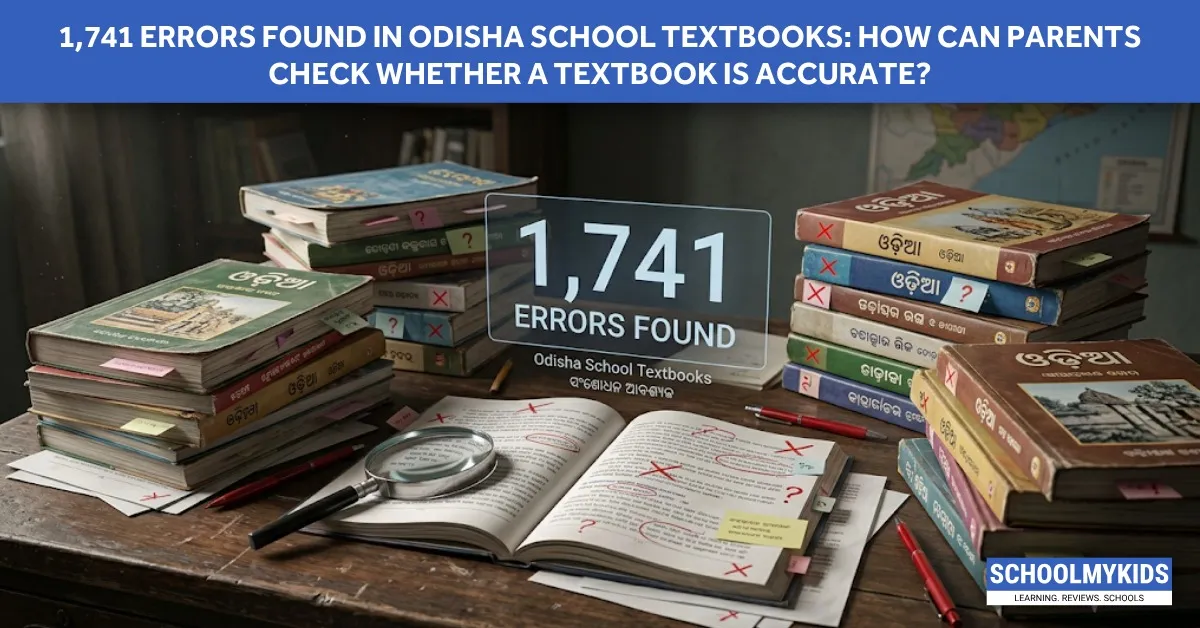
Odisha found 1,741 errors in school textbooks for Classes 1 to 8. Not typos scattered here and there. Significant problems. They spent ₹175 crore printing these books. Then realized the books had serious issues.
The biggest problems were in the Class 8 Science textbook (294 errors). Class 7 Urdu (121 errors). Class 8 Sanskrit (114 errors).
Most errors were grammatical, typographical, and spelling mistakes (1,075 of them). But there were also five factual and conceptual errors. Wrong information. Not just a misspelled word. Wrong facts that students memorise.
The government suspended the then director of the Directorate of Teacher Education and SCERT. Three assistant directors were suspended too. Disciplinary proceedings were started against six other assistant directors.
So it wasn't simple carelessness. It was negligence. Rushed timelines. Inadequate proofreading. Basically, nobody checked properly before printing ₹175 crore worth of books.
Why This Matters: Beyond Just Bad Printing
Your child reads a history textbook. It says something happened in 1947 when it actually happened in 1951. Your child memorises that fact. Studies it. Answers exam questions based on it. Gets it wrong.
This isn’t just about marks. It’s about what your child actually learns. Misinformation sticks. Your brain doesn’t know it’s wrong if nobody tells you.
A grammar mistake is annoying. It’s sloppy. But it doesn’t hurt learning much. Your child still understands the concept.
A factual error is dangerous. Your child is building knowledge on a wrong foundation.
In Odisha’s case, with only five factual and conceptual errors out of 1,741, they got lucky. But five is still five too many. The factual errors included a photograph of Karnataka’s Vidhan Soudha labelled as the Odisha Legislative Assembly, Niyamgiri Hills placed in Jharkhand, and the Konark Sun Temple misidentified.
Types of Errors: Which Ones Matter Most
Spelling And Grammar Mistakes
Imagine “Photosynthesis” spelled as “Fotosynthesis.” “Their” instead of “there.” These are annoying. Sloppy. But they don’t actually confuse learning.
Most of Odisha's errors were this type. 1,075 out of 1,741 were grammatical, typographical or spelling mistakes.
Typographical Errors
Numbers printed wrong. Formulas with missing symbols. Page numbers incorrect. These can confuse but usually aren’t catastrophic.
Factual Errors
Wrong dates. Wrong names. Wrong scientific facts. Wrong historical events. These are serious. Your child learns false information.
Only five in Odisha's case (grouped by the government as factual and conceptual). But each one matters.
Conceptual Errors
Wrong explanation of how something works. These are the worst because students memorise the wrong understanding. They build future learning on a faulty foundation.
How To Actually Check If A Textbook Is Accurate: Practical Steps
Step 1: Read The “About This Book” Section
Most textbooks have an introduction. Check when it was published. Who reviewed it. If it says “expert reviewed” or “peer reviewed,” that’s supposed to mean multiple people checked it.
Also look for the publisher’s contact info. If errors are listed, they might have a list of known errors.
Step 2: Cross-Check Facts With Reliable Sources
If the book says India’s first Prime Minister was X, check with another source. Google it. Check the official government website. Check Wikipedia (yes, Wikipedia can be edited by anyone, but major historical facts are monitored).
For science facts, check textbooks from other boards. NCERT books, for example, are generally well-reviewed.
Step 3: Look For Internal Inconsistencies
Does the book define something one way in Chapter 2 and differently in Chapter 5? Do the examples match the explanations? Internal inconsistency usually signals poor review.
Step 4: Check Dates And Numbers
These are easy to verify and often wrong. If the book says “The Industrial Revolution happened from 1750-1850,” verify those dates. They might be slightly off (sometimes books use different date ranges for different countries).
Step 5: Look At Images And Diagrams
Are labels correct? Do diagrams actually match the text? A mislabeled diagram can confuse learning completely.
Step 6: Read The Acknowledgments And Bibliography
Good textbooks cite where information comes from. If there’s no bibliography or acknowledgments, that’s suspicious. It means the author didn’t credit their sources.
What Parents Should Actually Do If You Find Errors
If You Find A Spelling Or Grammar Mistake:
Note it down. Report it to the school. The school can inform the publisher. For Odisha books, they’re already working on corrected editions.
If You Find A Factual Error:
This is more serious. Verify it’s actually wrong using multiple sources. Then:
Tell your child the correct information
Report it to the school immediately
The school should inform the textbook publisher
Document it (date, page, error, correct information)
If You Find A Conceptual Error:
Same process. But especially important to correct your child’s understanding before they build more learning on wrong foundation.
If The Book Has Many Errors:
Contact your state’s education department. File a formal complaint. Include specific examples. The government needs to know if textbooks are problematic.
Ask the school headmaster or class teacher whether the latest corrigendum or revised pages have reached them. Odisha issued correction sheets and started distributing revised editions. If your school has not received them yet, request them through the District Education Officer. Keep a note of the date you asked.
What Actually Went Wrong In Odisha and How To Avoid It
The government and the inquiry committee both pointed to the same causes: rushed timelines and inadequate proofreading. Subject experts were given only one day to review final manuscripts (earlier processes allowed months). There was no formal orientation for writers on translation and contextualisation. The same people often acted as writer, reviewer and final expert.
This is a process failure. Not necessarily individual incompetence. But process failures that hurt students.
The government says they’re implementing new measures: fact-checking by subject experts, language experts, revised review process.
Good. But takes time to implement.
Why Textbooks Get Errors: Understanding The System
Writing a textbook is complex. One person writes it. An editor reviews it. A subject expert reviews it. A language expert reviews it. Then it goes to print.
At each step, somebody might miss something. Especially if they’re checking quickly. Or if they’re not trained to catch specific types of errors.
Then the book gets printed in massive quantities. Thousands of copies. Only after printing do people realize the problems.
By then, it’s too late. The books are already in schools. Students are already reading them.
The solution would be better pre-printing review. But that takes time and money. The government is under pressure to deliver books on schedule. Quality sometimes suffers.
What Students Can Do: You’re Not Helpless
If you notice something in your textbook seems wrong:
Don’t just memorise it
Ask your teacher
Verify it using another source
Tell your teacher what you found
Teachers appreciate students who think critically and question sources. This is actually a valuable skill.
Don’t assume textbooks are always right. They’re written by humans. Humans make mistakes.
Key Takeaways
Odisha found 1,741 errors in school textbooks for Classes 1-8
Most were grammatical, typographical or spelling mistakes (1,075), but five were factual and conceptual errors
Factual errors are dangerous because students memorise false information
Parents should cross-check important facts using reliable sources
If you find errors, report them to school and education department
Textbook errors happen due to rushed timelines and inadequate review
Better pre-printing review could prevent this
FAQs
Q1: Should I not trust my child’s textbook if there are errors?
Don’t throw it away. But also don’t treat it as the only source of truth. For important facts (dates, definitions, scientific concepts), verify using another source. Most of the book is probably accurate. You just need to spot-check key information.
Q2: If my child learns something wrong from the textbook and answers it wrong on an exam, will the school correct the mark?
Depends on the school and how many students got it wrong. If many students made the same mistake because of the textbook error, the school might give bonus marks or count it as correct. If only one student got it wrong, they might not. Worth asking the teacher.
Q3: Is Odisha the only state with textbook errors?
Probably not. Other states likely have errors too, but the Odisha government was transparent about it. Not every state publicly admits to 1,741 errors. The difference is whether the state acknowledges problems and fixes them.
Q4: How long until corrected textbooks reach schools?
Odisha said corrected editions are being printed and distribution of the revised books began on 23 September 2026. But printing and distribution still take time. If your child's school still has the error-filled books, request the corrected version from the school administration. Don't let it slide.



Be the first one to comment on this story.