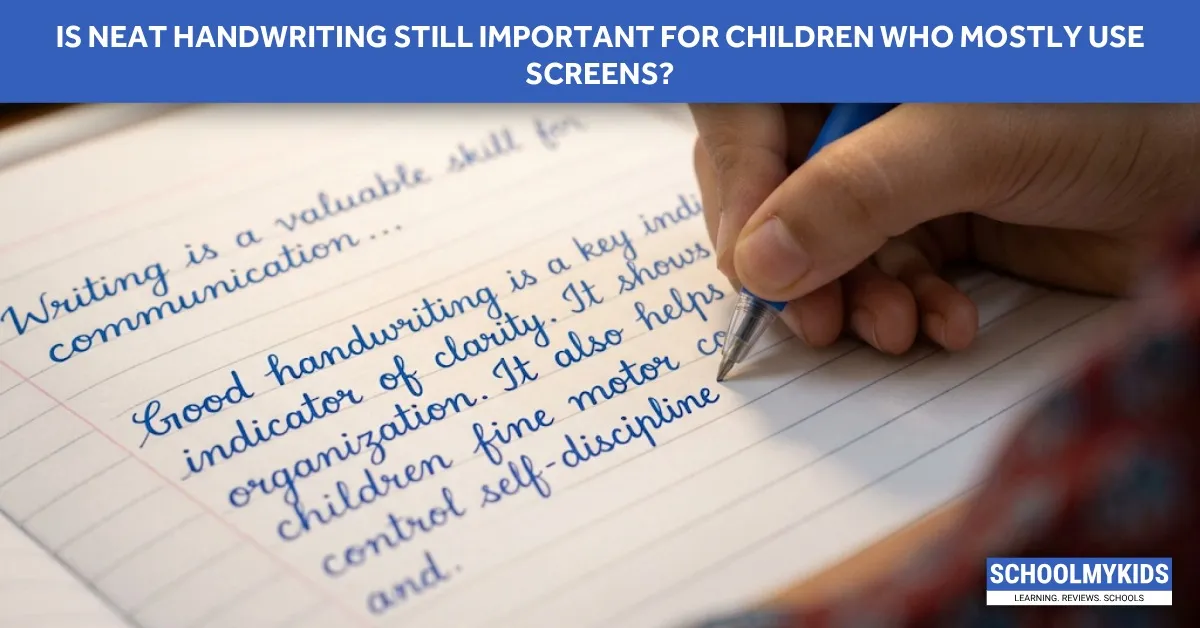
Your 12-year-old takes notes on a tablet. Homework submitted online. Exams on computer. When was the last time she actually held a pen for more than five minutes?
You remember school differently. Notebooks everywhere. Neat handwriting mattered. Teachers graded partly on presentation. Your mother made you practice cursive writing. Endless lines of “a” and “b” and “c.”
Now you’re wondering: does any of that still matter?
The honest answer is complicated. But yes, it matters. Just not for the reasons your parents thought it mattered.
What Actually Changed and What Didn’t
Schools have changed. That’s undeniable. Your kid’s school probably has a computer lab. Some classes are taught with projectors and presentations. Assignments get submitted through Google Classroom.
What people often miss is that most schools still teach handwriting. Most still have handwritten exams. Board exams (CBSE, state boards, ICSE) still require students to write by hand. Many competitive exams still do too, though the picture is mixed in 2026.
Even with all the screens, writing by hand is still part of your child’s life. Not as much as before. But it’s still there.
What changed is the weight it carries. Twenty years ago, sloppy handwriting could tank your marks. Teachers actually deducted points for messy writing. Your transcript suffered if your handwriting was bad.
Now? Handwriting is one small part of the overall grade. Your child’s ideas matter more. The content matters more. Handwriting is just the delivery method.
But it still matters. So, let’s explore why.
The Brain Thing: Why Handwriting Still Helps Learning
This is the part that surprises parents. When your kid writes by hand, her brain works differently than when she types.
Handwriting is slower. This forces her brain to actually think about what she’s writing. With typing, she can just type fast without really processing. With handwriting, she has to slow down. Think. Then write.
Research backs this up. A 2024 meta-analysis of 24 studies found that students who took and reviewed handwritten notes scored higher on achievement measures than those who typed (Hedges’ g = 0.248). Brain imaging work also shows handwriting produces broader connectivity across regions linked to memory and learning compared with typing. The act of writing by hand creates stronger memory traces.
Your daughter studies for exams. She types out her notes from the textbook. Then at the test, she forgets half of it. Why? Because typing is too easy. Her brain didn’t engage deeply.
Now imagine she handwrites her study notes. Takes longer. More effort. Her brain has to think about what matters. How to organize it. What to emphasize. When she gets to the exam, she remembers better.
This isn’t about handwriting being “better.” It’s about the slower process forcing deeper thinking.
Actual Handwriting Skills - Not Just Scribbling
There’s a difference between “handwriting” and “being able to write.”
Sloppy scribbling that’s unreadable? That’s a problem. Your child’s writing is so messy that even they can’t read their own notes. That’s not okay.
But perfect cursive that takes forever? That’s not necessary.
What actually matters is readable handwriting. Fast enough to keep up in class. Clear enough that teachers can read answers on tests. Neat enough that the student can read their own notes later.
That’s the actual standard. Not perfection. Just functional.
Most kids with screens actually have okay handwriting. They just don’t practice as much. When they do need to write, they can. It’s not beautiful. But it’s readable.
Some kids have worse handwriting because they literally don’t practice. Their hands aren’t used to holding pens. The muscles aren’t developed. When forced to write by hand (like during exams), they struggle.
The Exam Problem: This Is Where It Gets Real
Board exams are still handwritten. NEET remained pen-and-paper in 2026 (shift to computer-based planned from 2027). JEE Main is mostly computer-based, though the architecture drawing paper is still done by hand. Your child will still sit for hours writing by hand in the exams that matter most for school boards.
If her handwriting is terrible, the examiner might not read her answers clearly. Or she might write slowly and run out of time.
So yes, handwriting matters. Not because it’s traditional. But because exams require it.
A student who types everything for months, then sits for a three-hour exam requiring handwriting? She’s at a disadvantage. Her hand gets tired. She writes slowly. She struggles to maintain legibility when writing fast.
This is practical. Not about old-school values. This is about performing well on exams that actually matter for college.
What Parents Should Actually Do
Don’t force cursive writing practice. That’s outdated thinking. Your child doesn’t need perfect penmanship.
Do encourage occasional handwriting. Math assignments. Practice essays. Study notes. Nothing excessive. Just enough that her hand stays used to writing.
Before board exams, have her practice writing by hand for a few weeks. Get her hand used to the pace. Build up the stamina. This actually helps.
Consider her exam schedule. If she has board exams coming up, handwriting practice matters more right now. If she’s in Class 7, it’s less urgent.
Let her choose her writing style. Cursive. Print. Mix of both. Whatever she’s comfortable with. As long as it’s readable, it’s fine.
Don’t shame her about handwriting. Some kids naturally have prettier handwriting. Some don’t. It’s not a reflection of intelligence or worth.
The Digital Note-Taking Question
Should you let her take notes on iPad or laptop?
What research actually shows: for learning, handwriting is better. Her brain engages more deeply.
But practically? If her school requires digital submissions, she’ll need to type sometimes anyway.
Best approach: mix both. Some classes she takes notes by hand. Other classes, she types on the laptop. This gives her both benefits. Deep learning from handwritten notes. Efficiency from digital notes when needed.
For studying, handwriting is better. For daily classroom efficiency, typing might be faster.
It’s not either-or. It’s both.
What Schools Actually Expect
Most Indian schools still value neat handwriting. Not perfect. But neat and readable.
Teachers notice sloppy handwriting. They notice when a student writes so small that the text is illegible. They notice when speed sacrifices readability.
Will messy handwriting fail an exam? Probably not. But it might cost marks if the examiner literally can’t read the answer. CBSE has confirmed there are no extra marks for neat handwriting, but examiners must be able to read the answers clearly.
In competitive exams, judges are trained to read even sloppy writing. But if two answers are equally good, the one that’s easier to read might get the benefit of the doubt.
So yes, it matters. Not a lot. But it matters enough to be worth attention.
The Confidence Thing: Underrated But Real
Kids with bad handwriting feel self-conscious about it.
Your daughter writes slowly by hand. Feels embarrassed. Avoids handwriting assignments. Gets stressed during exams because she knows her writing looks messy.
This stress actually hurts performance. She’s thinking about her handwriting instead of focusing on the content.
A student with decent handwriting? She writes the exam without worrying about how it looks. She focuses on the content. Better performance overall.
This isn’t about vanity. It’s about reducing anxiety and improving focus.
When Handwriting Trouble Might Need Extra Attention
Most kids just need more practice. A few need more than that.
If your child is already in middle or high school and still struggles to form letters, holds the pen in a painful grip, tires after ten minutes, or avoids any writing task with real distress, it is worth a quiet chat with the class teacher or a paediatric occupational therapist. Sometimes the issue is simple muscle strength or posture. Sometimes it is something that responds well to short, targeted exercises. Catching it early prevents exam-day panic later.
This is not about labelling anyone. It is simply about giving the hand the support it needs so the brain can focus on the answers.
Different Handwriting Styles Your Kid Might Develop
Some kids develop very small, cramped handwriting. Advantages: fits more on a page. Disadvantages: hard to read, takes strain.
Some develop large, loopy writing. Advantages: easy to read. Disadvantages: runs out of space fast.
Some mix print and cursive randomly. Advantages: fast. Disadvantages: inconsistent, sometimes hard to read.
None of these is “wrong.” They’re just different. What matters is whether it’s readable and reasonably fast.
Some teachers have strong opinions about which style is “correct.” Ignore them. As long as it works, it’s fine.
More Practical Stuff: Pen Choice Matters
Your kid’s pen matters more than you’d think. A cheap, uncomfortable pen makes handwriting worse.
Get her a pen she actually likes. Smooth writing. Comfortable grip. Something she wants to use.
Different pens feel different. Some students write better with gel pens. Others prefer ballpoint. Some like thicker pens. Some like thin pens.
Let them experiment and find what works. This small thing actually improves handwriting quality.
Also: pencils versus pens. Pencils are easier to erase. Pens look neater. For practicing, pencils are fine. For exams, they’ll probably use pens.
Key Takeaways
Handwriting still matters because exams require it
Typing doesn’t replace handwriting, just supplements it
Readable handwriting is the actual goal, not perfection
Handwriting improves learning through deeper processing
Build handwriting stamina before board exams
Let them find their own writing style
Don’t stress about it, but don’t ignore it completely
FAQs
Q1: My child types everything and almost never writes by hand. Should I be worried?
Somewhat. Not panic-level worried, but worth addressing. If board exams are coming up, she needs practice with handwriting. Her hand needs to build stamina for three-hour exams. Start having her handwrite some assignments. Maybe study notes. Get her used to writing again before the actual exam. If she’s young and exams are years away, it’s less urgent but still worth occasional practice.
Q2: Does the quality of her handwriting affect her exam marks?
Indirectly, yes. The examiner has to be able to read her answer. If writing is illegible, the examiner might miss important points. Very sloppy handwriting can cost marks. But perfectly beautiful handwriting doesn’t gain marks either. It just needs to be readable. Clear enough that an examiner can understand what she wrote.
Q3: Should I force her to practice handwriting every day?
No. Daily practice isn’t necessary and builds resentment. But occasional handwriting helps. Math assignments by hand. Practice essays handwritten. Study notes in her own handwriting. One week before exams, increase handwriting practice to build stamina. This is enough.
Q4: Is cursive writing still important to learn?
Not really. Schools teach it because it’s traditional, but it’s not essential. Legible print handwriting works fine. Cursive is nice if they enjoy it, but don’t force it. Many exams accept printed handwriting. What matters is being able to write quickly and legibly in whatever style comes naturally to them.






Be the first one to comment on this story.