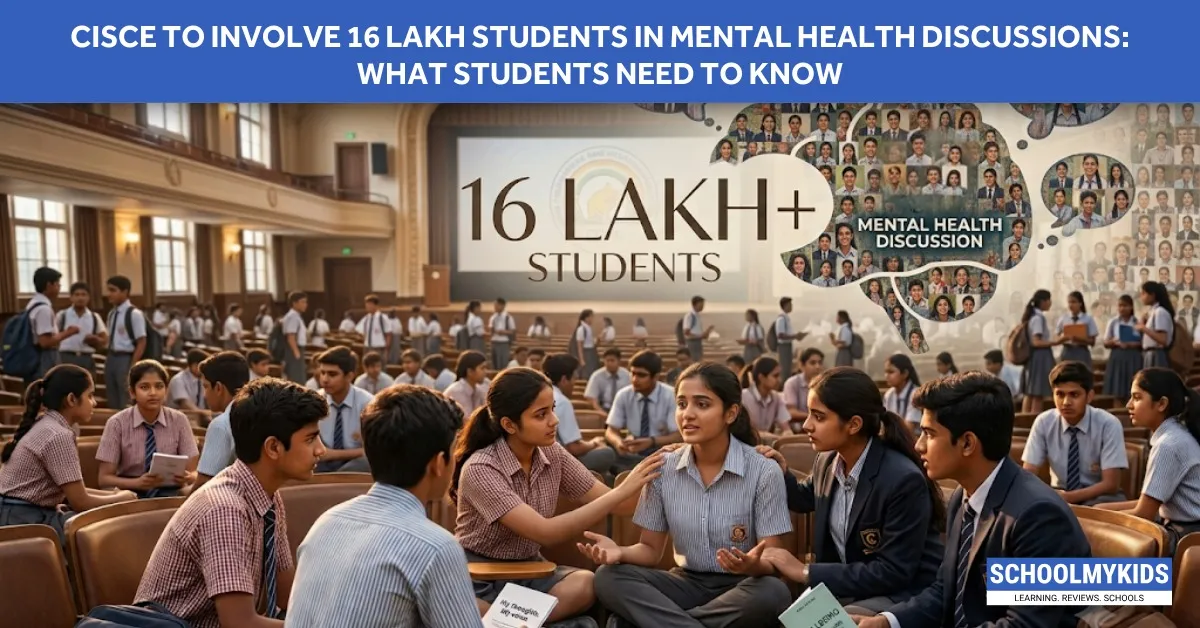
Your school is probably going to have mental health discussions starting in October. Not just a guest speaker who shows up and leaves. Actual classroom conversations.
CISCE (the board that runs ICSE and ISC schools, including well-known ones like Cathedral & John Connon School) is organizing this. About 16 lakh students will be part of it. Classes 6 through 12.
The discussions run from 4 to 31 October. Then regional conclaves (virtual, across 18 regions) happen from 4 to 14 November. Finally, a national conclave at the CISCE Centre of Excellence in Hyderabad from 20 to 22 November where 72 selected students (plus 18 teacher mentors) will present what emerged from the school and regional discussions.
This isn’t just adults talking about mental health to students. It’s students actually talking about their experiences. Their stress. Their relationships. Their concerns about substance abuse. How they handle pressure.
Why Your School Is Doing This
Schools have realized something. Lots of students are struggling mentally. Exam pressure. Social media stress. Peer pressure. Family expectations. Academic competition.
Student suicides in India reached a record 14,488 in 2024 according to NCRB data, rising faster than the overall suicide rate. A 2026 study of more than 8,500 students found overall well-being falling from 62 percent in Grade 8 to 43 percent in Grade 12.
Most schools didn’t have space to talk about this openly before. Mental health was treated like a private problem. Your grades are dropping? That’s your problem. You’re anxious? That’s your problem.
But that doesn’t work. When students are struggling mentally, everything suffers. Your grades. Your sleep. Your relationships. Your ability to think clearly.
So CISCE decided: let’s make space for this conversation. Let students talk about what’s actually going on. Let teachers listen. Let schools figure out how to help better.
The Four Topics Being Discussed
Stress and Academic Pressure
This is real for you. Tests. Board exams. College entrance exams. Parents’ expectations. Peer comparison. Too many subjects. Too much homework.
The conversation isn’t “stress is bad.” It’s “this is what students actually feel, and here’s what helps.”
Emotional Well-being, Digital Life, and Relationships
Your phone. Social media. FOMO. Comparing your life to filtered Instagram versions of other people’s lives. Online harassment. Friendships that happen only through screens.
But also real relationships. With friends, family, teachers. What makes relationships healthy. When to reach out for help.
Drugs and Substance Abuse
Schools don’t usually talk about this honestly. But students see it. Friends doing things. Pressure to try things. Curiosity about things.
The discussion isn’t “drugs are evil.” It’s “here’s what actually happens, here’s why people are tempted, here’s what you can do if you or a friend is struggling.”
Building Resilience and Asking For Help
This is the important one. Life is hard sometimes. You fail. You get rejected. You feel lost. The question is: what do you do then?
Resilience isn’t “being tough.” It’s knowing how to handle difficulty. It’s knowing who to talk to. It’s bouncing back instead of breaking.
What Actually Happens In These Discussions: Not A Lecture
Your teacher doesn’t stand at the front giving you facts about mental health.
Instead, you talk. Share experiences if you want. Listen to what others are going through. Probably realize lots of people feel the same stuff you feel.
The point is listening. Your school acknowledging that students have real concerns. Your teachers actually hearing what’s going on.
Some students will share. Some won’t. That’s fine. Just listening to others helps.
Why This Matters For You Specifically
You’re growing up with unique pressures. Your parents had different problems. They’re comparing your world to theirs and not understanding why you’re stressed. They say things like “when I was your age, I didn’t have phones” or “just focus on studies.”
But your world is actually different. You’re constantly connected. You’re seeing everyone’s success stories simultaneously. You’re competing globally for college seats, not just locally.
Having a school forum to talk about this explicitly changes things. It validates that your stress is real. It’s not just “you’re not trying hard enough” or “you’re too sensitive.”
What The National Conclave Actually Does
Seventy-two students from across the country, along with 18 teacher mentors, will go to Hyderabad from 20 to 22 November. They’ll present what students are actually experiencing. Teachers will be there. Mental health experts will be there.
The goal is to create something called the Student Mental Health Charter. The charter is meant to set out principles, rights, responsibilities and practical recommendations for schools. CISCE is also looking at a Student Well-being Index, a collection of school practices that already work, and a white paper on emerging adolescent mental-health concerns. None of that is final yet. It depends on what students actually say in October and November.
It’s not written by adults alone. It’s written based on what students actually said.
This charter could change how schools operate. How they handle exams. How they treat students. How they support struggling students.
If it works, CISCE has said it may turn this into a biennial exercise timed around World Mental Health Day on 10 October.
What You Should Actually Do With This: Practical Steps
When the discussions happen in your school (October):
Show up. Don’t think of it as another school event. This is actually about you.
Share something if you’re comfortable. Even a small thing. “I get nervous before tests” is enough. You don’t have to spill your life story.
Listen to what others say. Probably realize lots of people feel things you thought only you felt.
If something shared resonates:
Talk to your school counsellor. Or your parents. Or someone you trust.
These discussions are meant to open doors, not close them. If the discussion made you realize you need help, seek it.
Think about what would actually help you:
What does your school do that makes stress worse? What would make it better?
If your school asks for feedback, give honest feedback.
Quick Resources If You Need Help Right Now
If the discussions bring up something heavy, you do not have to wait for the next class.
School counsellor or class teacher
Parents or a trusted adult
Tele-MANAS (government mental health helpline): 14416
iCall (TISS): 9152987821
These numbers are free and available when you need them.
What Mental Health Actually Means: Not What You Think
Mental health isn’t just “not being depressed.” It’s broader.
It’s your emotional state. How you handle stress. Whether you have good relationships. Whether you feel like life has meaning. Whether you can focus and think. Whether you can deal with difficulty.
A person can be mentally healthy even if they’re stressed. They just have ways of handling it.
A person can be mentally unhealthy even if they’re “successful” by grades or achievements. Because they’re miserable.
Schools teaching about this means helping you develop actual skills. How to notice when you’re stressed. How to calm yourself. How to talk to someone when things are hard. How to support friends who are struggling.
The Reality Behind The Initiative
Mental health issues among teens have been rising. Anxiety. Depression. Self-harm. Substance use.
Schools contributed to this without realizing it. Too much pressure. Too much focus on marks. Not enough listening.
CISCE isn’t doing this because they suddenly cared. They’re doing it because the problem got visible. Student deaths. Visible mental health crises. Parents complaining. Teachers overwhelmed.
This is the response. Better late than never, but worth noting.
What Won’t Change: Be Realistic
Your board exams are still happening. Your marks still matter for college. This initiative doesn’t remove academic pressure.
What it does is acknowledge the pressure is real and help you handle it better.
Timeline at a Glance
4 to 31 October: Classroom discussions in your school
4 to 14 November: Regional virtual conclaves (18 regions)
20 to 22 November: National conclave in Hyderabad
Outcome: Student Mental Health Charter based on what students shared
Key Takeaways
CISCE mental health initiative involves 16 lakh students in October-November 2026
Discussions cover stress, relationships, substance abuse, resilience
School-level talks, then regional, then national conclave
Creates Student Mental Health Charter based on what students say
Goal is helping schools become more supportive
Your honest participation matters
This doesn’t remove academic pressure but helps you handle it
FAQs
Q1: Do I have to share personal stuff in these discussions?
No. Sharing is optional. You can just listen. Many students will share nothing and that’s fine. The point is having the conversation happen at all. Just hearing what others experience helps even if you don’t speak.
Q2: If I tell my teacher something during the discussion, will it get back to my parents?
That depends on what you share. If you mention general stress, that’s probably fine. If you mention something serious like self-harm or substance use, your school might reach out to parents. Schools have a responsibility to help if someone is actually at risk. But the goal isn’t to get you in trouble. It’s to get you help.
Q3: What if my school doesn’t run these discussions properly?
Some schools will handle this well. Some won’t take it seriously. If your school isn’t doing it or is doing it poorly, you can talk to your parents or your school leadership. Also, the discussions are supposed to happen October 4-31. If your school hasn’t scheduled anything by mid-October, that’s worth asking about.
Q4: Will this actually change anything or is it just talk?
The national conclave will create a Student Mental Health Charter. That’s a document with actual recommendations. Whether your school follows it depends on your school. But CISCE taking this seriously means schools that ignore it look bad. So there is pressure for change. It won’t happen overnight, but this is real momentum toward schools taking mental health seriously.




Be the first one to comment on this story.