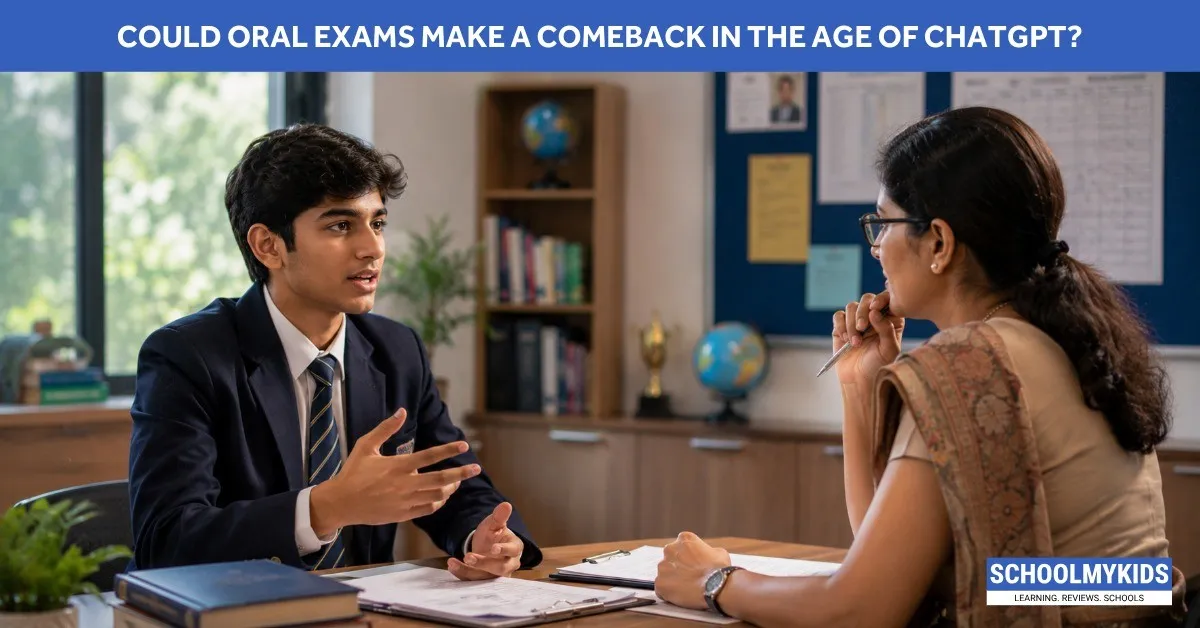
Your CBSE practical exam already has a viva-voce component, and most students ignore it.
You knew this. Somewhere in your school handbook, it said viva-voce was part of the practical exam. Five marks out of the 30-mark practical (about one-sixth of the practical component). But how many students actually prepared for it seriously?
In January 2026, Delhi University students sitting for their practical exams in Physics, Chemistry, and Biology spent weeks setting up experiments. Preparing reports. Memorizing procedures. Then, when the external examiner asked them basic questions about why they did something a certain way, their minds went blank.
The student who prepared the apparatus perfectly but couldn't explain what was happening scored lower than the student who messed up the experiment slightly but could describe the entire process clearly.
This is what's changing in Indian education right now.
What's Actually Happening In Indian Universities
UGC’s existing plagiarism regulations, applied through 2025-26 institutional guidance, now treat unacknowledged AI-generated content as academic misconduct on the same similarity bands used for text plagiarism. Many universities run theses and major assignments through detection tools. Turnitin flags AI-generated sections. DrillBit, used by more than 1,150 Indian institutions under the ShodhShuddhi programme, also provides AI-content scores.
The consequence is that Indian professors are starting to ask students to defend their work orally. Especially in postgraduate programs where thesis submissions matter.
But even at the undergraduate level, professors are shifting. They're asking students to explain assignments verbally. To discuss their projects. To justify their work in real time.
Because ChatGPT can write something perfect. But ChatGPT can't sit in front of a professor and explain it coherently.
CBSE’s Viva-Voce Carries Real Marks (And Students Are Still Underprepared)
For Class 12 science students, viva-voce is a fixed 5 marks out of the 30-mark practical. Class 10 Science includes a viva element inside the 20-mark internal assessment.
January 2026 practical exams showed something predictable. Students who practised viva questions with their teachers consistently scored higher in the viva component. Those who arrived without practice often lost several marks. Even a 3-4 mark difference in a 5-mark viva affects the overall practical total and can shift the final subject percentage.
The CBSE guidelines say examiners will ask questions about:
Why you chose this particular procedure
What would happen if you changed X variable
How this connects to the theory you studied
What errors you noticed and why they happened
These aren't trick questions. They're checking if you actually did the work and understood it.
Why NEP 2020 Is Pushing Competency-Based Assessment (Which Means More Oral Exams)
The National Education Policy literally says competency-based learning is the priority. Not memorization. Competency.
Memorization you can do with ChatGPT. Tell it to summarize a chapter, memorize the summary, done.
Competency means you can actually apply knowledge. Explain concepts. Solve new problems. Defend your understanding.
You can't fake that in an oral exam.
CBSE is aligning with this. Science subjects have practical vivas. Some humanities classes are introducing project-based oral defenses. Commerce students are presenting their projects orally.
The direction is clear: written exams remain important, but oral and performance-based assessments are gaining weight as ways to verify actual competency.
The Real Problem Indian Students Face
Most Indian students have never had formal oral exams until college. Your school never taught you how to speak about academic content coherently. Never trained you to think on your feet. Never made you practice explaining concepts to an authority figure.
Then in college, suddenly you're sitting in front of a professor who asks you something and expects you to answer in proper English while explaining complex concepts. Under pressure.
Students from private English-medium schools sometimes handle this better. They've been presenting projects and speaking English regularly. Students from schools where everything is in Hindi or a regional language sometimes struggle harder. Not because they don't know the content. Because speaking academic content in English is unfamiliar.
This inequality is real.
How To Actually Prepare For Viva-Voce Exams
Before your practical exam:
Talk through your experiment/project out loud. No notes. No reading. Just speaking. Notice where you get confused. Those are the gaps in your understanding.
Record yourself. Listen back. Do you sound confident? Are you actually explaining or just reciting? If you're just reciting, you'll blank out under exam pressure.
With your teacher:
Ask your teacher to conduct a mock viva. Actual questions. Actual timing. The discomfort in practice prevents worse discomfort in the exam.
Prepare for follow-ups:
Think about what could go wrong in your experiment. Why it happened. How you'd fix it next time. Your examiner will ask this. Have answered it already.
Common viva questions in CBSE:
"Explain the principle behind this experiment"
"What would happen if we changed X"
"What are the sources of error"
"How did you minimize error"
"What is the significance of this in real life"
These repeat across subjects. Be prepared for these patterns.
What UGC Means For College-Level Assessments
For anyone writing assignments in college, the new reality is this: Major assignments are getting oral defense components. Especially in humanities and social sciences where essays were previously the only assessment.
Your professor might ask you to submit a written assignment, then explain it verbally. Or submit it and defend it in a group discussion.
This isn't punishment. It's verification. They want to know the thinking is yours, not ChatGPT's.
The Tool That Actually Helps (For Free)
Google's NotebookLM (free; Indian students can access it) lets you upload course materials and have a conversational AI quiz you on them. It's not perfect, but it mimics the viva experience. You're retrieving information orally under pressure from an entity asking follow-up questions.
Practice with this for 15 minutes daily leading up to your exam. It conditions your brain to speak academic content fluently.
Key Takeaways
CBSE viva-voce is 5 marks out of the 30-mark practical; students typically underprepare
UGC guidelines on AI plagiarism encourage universities toward oral assessment
NEP 2020 competency-based focus means more oral exams, fewer pure memorization tests
Students from regional-language backgrounds face extra pressure speaking academic English
Major college assignments increasingly include oral defense components
Practicing oral explanation reveals knowledge gaps that written study hides
Mock vivas with teachers significantly improve actual exam performance
AI tools can assist test preparation through conversational quizzing
Frequently Asked Questions
Q1: Is viva-voce only for science subjects?
CBSE science subjects have it as standard. Increasingly, even commerce and humanities projects require oral presentations. It's spreading.
Q2: Can I answer viva questions in Hindi/regional language?
Some teachers allow this in schools. In board exams, technically you can ask, but English is safer. In college, check with your professor. UGC doesn't mandate English specifically.
Q3: What if I don't know an answer during viva?
Say "I'm not sure" or "I haven't studied that yet." Better than making something up. Examiners respect honesty more than BS.
Q4: How much does viva really affect my marks?
Five marks in a 30-mark practical is still significant. A swing of even 3-4 marks in the viva can shift the overall subject percentage enough to affect the final grade.
Q5: Do Indian colleges have comprehensive oral exams like foreign universities?
Increasingly, yes, especially postgraduate programs. Masters theses often have oral defenses now. Some undergraduate programs are starting to adopt it too.


Be the first one to comment on this story.