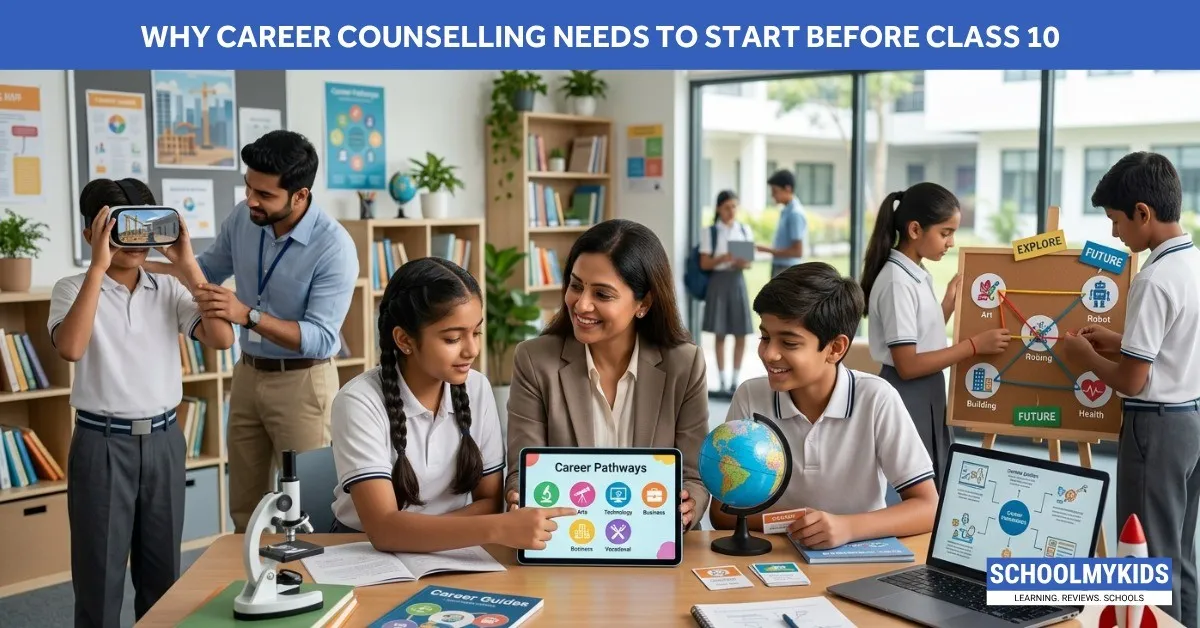
You’re in Class 9. Your friends are already talking about which stream they’re taking. You have no idea what you want. That panic you’re feeling? That’s the reason counselling should’ve started two years ago.
By the time Class 10 arrives, most students have already decided their stream. A 2025 UNICEF-YuWaah and iDreamCareer study of over 21,000 Class 9–12 students found only 10.4 percent had ever received professional career guidance, so the rest decide with whatever information is closest. Science. Commerce. Humanities. They’ve told their parents. They’ve told their friends. It’s “decided.”
Except most of them decided based on what their best friend was doing. Or because science sounds smart. Or because their parents said so. Not because they actually tested themselves, looked at options, or figured out what they’re actually good at.
That decision shapes the next decade of your life. The subjects you study in Class 11-12. The college you can get into. The career paths available to you. Everything branches from that one choice.
And you made it when you were 14. Without any actual information about yourself.
What Actually Happens When You Wait Until Class 10
You’re sitting with your guidance counsellor in October of Class 10. They ask what stream you want. You say science because that’s what you said before. They ask why. You can’t really answer that. You just know most people take science.
Then they ask what you want to do later. You say “doctor” or “engineer” because those are the jobs you’ve heard of. They ask if you’re good at the subjects needed for that. You shrug. You don’t know. You’ve never tried anything except what’s in your textbook.
Then they give you a form to fill and send you out.
That’s not counselling. That’s a checkbox. Real counselling needs time. It needs assessments. It needs you to try things and fail at some things and succeed at others. That takes months. Not weeks.
What Your Brain Actually Needs To Figure Out Before Class 10
By Class 9, you should know some basic stuff about yourself.
What subjects actually interest you? Not what sounds impressive. What do you actually enjoy reading about or thinking about? If you had to read about something for fun, what would it be? That matters.
What are you actually decent at? Not what you get good grades in. Those might be completely different. You might be crushing Math but hate it. You might be struggling with English but love writing. Those are different things.
How do you actually work? Do you like working alone or with people? Do you prefer following instructions or making your own plan? Are you good under pressure or do you fall apart? Do you learn by doing or by reading? These aren’t obvious. Most people don’t know until someone asks.
What matters to you in a career? Money? Helping people? Building things? Working outside? Travel? Job security? Doing something nobody else is doing? If you don’t know, you’ll just follow whatever path is in front of you.
That’s what counselling actually figures out. And it takes time.
The Actual Stupid Thing That Happens If You Don’t Start Early
You get to Class 11. You realize you hate your stream. You want to switch. Your school says no. Your parents say no because you already committed. So you spend two years miserable, scoring badly, hating everything.
Then you finish Class 12. You try to get into a college for a different stream. It’s harder because you don’t have the right prerequisites. Or you don’t make the cutoff. Or you end up in a backup college for a field you don’t care about.
Four years later, you’re in college studying something you picked when you were 14 and didn’t actually want. You’re competing with people who chose this field on purpose and are way more engaged.
Switching later is possible but painful. The time to figure this out was earlier.
Why Class 8 Actually Makes Sense
We know this sounds young. But let’s see why it’s the right time.
You still have flexibility. Your brain isn’t locked into “this is who I am.” Your future still feels open. You’re curious about things. You haven’t had two years of people telling you what to be yet.
Also, Class 8-9 is when you start developing actual academic strengths. You’ve taken enough subjects long enough to know what actually clicks for you versus what you’re faking your way through.
Plus, starting early means you have time. If counselling suggests you try coding, you have a year to try it before stream choice. If it suggests you focus on writing, you have time to develop that skill. You’re not making the final decision right after you discover something about yourself.
NEP 2020 and the later CBSE circulars of 2025–26 both push structured career guidance from middle school onward, not from the board-exam year.
What the Numbers Actually Show
Only one in ten Indian students in Classes 9–12 has ever sat with a professional career counsellor (UNICEF-YuWaah and iDreamCareer, 2025). The same study found 81 percent face barriers that include family pressure, peer influence, and almost zero self-awareness data. Meanwhile, 93 percent of students aged 14–21 still name only seven career options even though more than 250 exist. That is why waiting until Class 10 is already late.
What’s Actually Happening In The Job Market Right Now (2026)
The jobs your parents trained for don’t exist anymore. The jobs you think exist might not exist in five years.
AI is automating stuff nobody expected would automate. Skills that were rare are becoming common. Completely new roles are opening that didn’t exist five years ago.
An aptitude test from 2000 would never have mentioned data scientist, AI trainer, or prompt engineer. Those roles only became mainstream after 2015–2020. In 2026, they are already shifting again. Hiring data shows prompt-engineer titles plateauing while agentic-AI and AI-orchestration roles are rising 180–260 percent year-on-year.
Without counselling, you’re picking a stream based on jobs you know about. But you don’t know what you don’t know. A good counsellor knows the job market and can tell you what’s actually hiring now, what skills are actually in demand, and what’ll be outdated in five years.
What You Think You Want Is Probably Wrong
You want to be a psychologist because you like talking to friends. That’s not the job. You want to be a filmmaker because you like Instagram Reels. That’s different. You want to be a doctor because it sounds impressive. But you hate dealing with blood or people’s pain.
You literally don’t know what these jobs actually are. Counselling helps with that. It introduces you to what work actually looks like. Not the glamorous version from movies. The actual job.
Key Takeaways
Stream choice in Class 10-11 shapes the next decade of your education and career
Most students choose streams based on peers, parents, or assumptions, not actual self-knowledge
Switching streams is usually possible only in the first 1–3 months of Class 11. After that, most schools treat it as a full-year setback
Counselling needs time to work - starting Class 8-9 gives that time
You need to know your actual strengths, interests, and work style before choosing streams
Job market is changing rapidly. A good counsellor tracks what is actually hiring in 2026, not what parents knew in 2005
Early counselling prevents years of regret and misaligned choices
By Class 10, most students have already decided without real information
Frequently Asked Questions
Q1: Isn’t Class 8 too early? I don’t even know who I am yet.
Exactly. That’s why you should talk to someone now. You don’t need to have it figured out. A counsellor helps you figure it out.
Q2: My school doesn’t offer career counselling. What do I do?
Look for online counselling. Prices for a single session still start around 2,000–3,500 rupees. Full assessment-plus-follow-up packages run higher. Some schools have relationships with counsellors who come in. Talk to your parents about getting one even if the school doesn’t offer it.
Q3: What if I do counselling and still change my mind later?
That’s fine. Counselling isn’t about locking you in. It’s about making informed decisions now instead of random ones. If you change your mind later, you’ll have way more information to base that new decision on.
Q4: I’m already in Class 10. Is it too late?
Not entirely. But you’ve lost time. If you haven’t chosen a stream yet, get counselling immediately. If you have, counselling can still help you understand your choice better and prepare accordingly.
Q5: How do I know if a career counsellor is actually good?
They should ask questions more than they tell you answers. They should give you assessments (aptitude tests, personality tests). They should help you explore options rather than narrow them. They should listen to you more than they talk.






Be the first one to comment on this story.